



When I train clients on the basics of their websites, I often use an analogy I came up with years ago. People tell me it helps, and I’ve kept simplifying it over time. Most of my clients don’t want to know all the ins and outs of how the internet works, but they do appreciate seeing how the puzzle pieces fit together.
To explain how domain names, DNS, IP addresses, web hosting, websites and email work together, I compare them to your home, your street address and even the post office. Here’s how each piece lines up:
- Domain name is like your street address.
- DNS is like the map or GPS that leads people to your property.
- IP address is like your property’s government tax ID.
- Web hosting is like your parcel of land.
- Website is like your house.
- Email is like your mail.
I’ll go through them in the same order most people would set up a website if they were doing it themselves.
Domain name

If you’ve ever tried to build your own website, you probably started by finding a domain name. That makes sense. You need a way to identify your business on the internet, so the first step is registering a domain. The company you register it with is called a “domain registrar.” They provide the registration service, but you own the rights to the domain name. (Here’s how to make sure you truly own your domain.)
A domain name is like the street address of your home. When someone wants to visit, your street address helps them find you. It’s the easy-to-remember version of your location, instead of your parcel’s tax ID or the lot and block numbers of your subdivision.
DNS
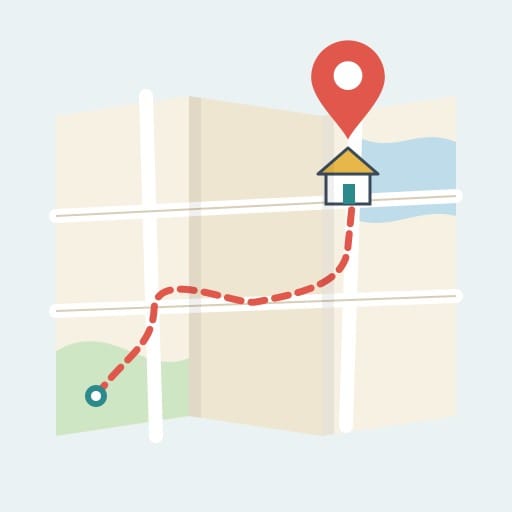
DNS stands for Domain Name System. It’s the behind-the-scenes directory that connects your domain name to the server where your website lives. When someone types in your domain, DNS looks it up and points their browser to the right place. DNS also tells the world where to deliver your email.
In our analogy, DNS is like the map or GPS that turns a street address into directions to your front door. Your address alone doesn’t get anyone there; the map does.
IP address

You’ll rarely have to deal with IP addresses yourself, but they’re what actually tell the internet where your website is located. Every server on the internet has an IP address, a string of numbers that computers use to find each other.
In our analogy, an IP address is like the government tax ID assigned to your property. Every property has an ID number besides its street address, which government agencies use to keep track of it. If you own your home, you may have seen that parcel number on a tax or mortgage bill. If you rent, the whole property has a parcel number, and your home is identified by an apartment number.
Web hosting

A web hosting company provides space on a server for your website, along with the connection that lets visitors reach it. A host doesn’t necessarily build your website for you. Your website lives at the host’s IP address, and DNS points your domain name there.
Many websites are hosted in a “shared” environment, where lots of websites live on the same server and share the same IP address. Each website has its own space, and when someone visits your domain, the server sends them to the right one.
Web hosting is like the parcel of land your house is built on. Shared hosting is a bit like living in an apartment or condo building.
Website

A website is software that lives on a web hosting server. There are a few ways to build one: you can learn the software and build it yourself, use a website builder (like Wix or Squarespace), or hire a professional to build it for you.
Your house is your website in our analogy, and there are a few ways to build a house, too. You might buy supplies at Home Depot and build it yourself, buy a kit with everything you need (think dome house) and assemble it, or hire a contractor to build it to your specifications.
Building your own website without any knowledge of web development is a lot like building your own house without any knowledge of construction.

Your domain name lets you have professional email addresses, like [email protected], each delivered to its own inbox. There are two main ways to handle that email.
Some web hosts offer email on the same server as your website. That’s like having your mail delivered to the mailbox in front of your house. It works, but if something goes wrong with your hosting, your email can go down along with your website.
Today, most businesses use a dedicated email service like Google Workspace or Microsoft 365. That’s like renting a post office box. Your mail goes to a separate, secure location that keeps working no matter what’s happening at your house, and you can check it from your computer, phone or tablet. This is what we recommend for most businesses, and we can set up and manage Google Workspace for you.
Putting it all together
You can put all these pieces together yourself, but learning how to assemble the puzzle can take a lot of time, time you could spend running or growing your business. Five Point Web Solutions can bring it all together for you. We build WordPress websites, and our Website Management Plan takes care of hosting, DNS, email delivery from your website, security and updates, so you can focus on your business.



Add your first comment to this post